
Just three weeks ago, I wrote about how Bury Council’s financial chickens were coming home to roost. I warned that years of spending reserves to prop up day-to-day spending was unsustainable and that Bury Labour were heading towards a financial cliff edge.
Unfortunately, the newly published draft 2027/28 budget shows that the situation is even worse than I feared.
What was dismissed by some as opposition scaremongering has now been confirmed by the council’s own finance officers. The reality is stark: reserves are running out, residents are facing service cuts and higher charges, and Bury Council is now preparing to approach the Government for Exceptional Financial Support, effectively asking Whitehall for help to balance the books.
The question residents should be asking is simple:
How did Bury Labour allow things to get this bad?
The Warning Signs Were There
For over a year, Bury Independents have repeatedly warned that the council was becoming increasingly dependent on reserves to plug recurring budget gaps.
Instead of addressing the structural problem, Labour continued to spend reserves while hoping future savings, future growth and future Government funding would somehow rescue the situation.
Now the numbers are impossible to ignore.
The council admits it faces a cumulative budget gap of nearly £35 million over the next three years before any savings are applied, including over £20 million in 2027/28 alone. Even after nearly £17.5 million of proposed savings and cuts, there is still a funding gap of £17 and a half million remaining across the period.
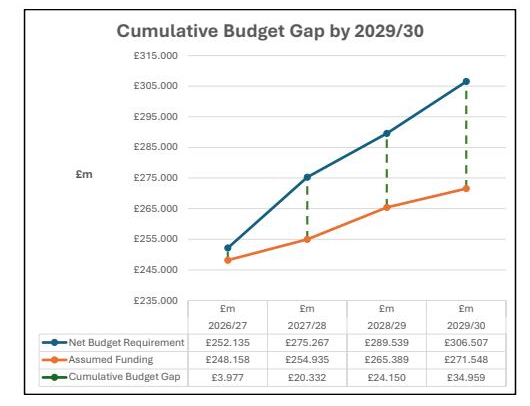
This is not a temporary wobble.
This is a council whose spending is growing significantly faster than its income.
Reserves Have Been Burned Through
The most shocking section of the budget report concerns reserves.
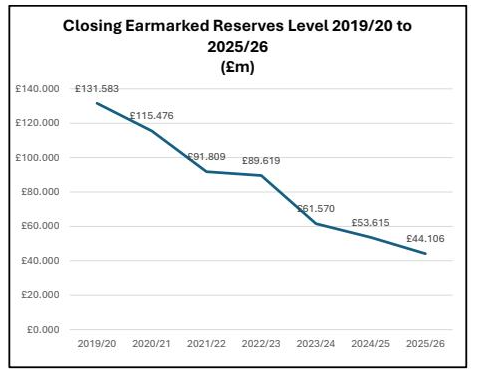
Back in March 2020, Bury Council had earmarked reserves of £131.6 million.
By March 2026 those reserves had fallen to £44.1 million, a staggering reduction of £87.5 million, or 66%. The council’s own report states that reserves are being depleted faster than they can be replenished and that the trend is unsustainable.
Even worse, the Budget Stabilisation Reserve, effectively the council’s financial emergency fund, is forecast to fall from £15.6 million to less than £6 million by March 2027.
The draft budget openly admits that the remaining reserve is insufficient to cover the £9.585 million budget gap forecast for next year.
In plain English, the council has pretty much run out of financial cushions.
Going Cap in Hand to Government
Perhaps the biggest political embarrassment for Bury Labour is hidden in the recommendations section.
The council is seeking authority to begin discussions with the Ministry of Housing, Communities and Local Government regarding Exceptional Financial Support (EFS).
Exceptional Financial Support is not something councils seek when things are going well.
It is the route councils take when they cannot see a credible path to balancing their budget through normal means.
The draft report even acknowledges that the Government can permit councils receiving EFS to raise council tax above normal referendum limits.
Residents should be deeply concerned about this.
Today Bury Labour proposes a 4.99% council tax rise. Tomorrow they may be asking Government for permission to raise it even further.
What Residents Will Notice
The budget document contains dozens of savings proposals.
Many look small when viewed individually.
Taken together, however, they paint a worrying picture.
School Crossing Patrols Face Devastating Cuts
As someone who has campaigned to protect school crossing patrols, this proposal is particularly alarming.
The council intends to “significantly reduce” the service, retaining only crossings deemed high risk.
The report reveals:
- Only six crossing points would be retained as high priority.
- Six are considered medium priority.
- Twenty-six are considered low priority.
- Thirty-two crossing points could be removed.
- Fifteen crossing patrol posts would disappear.
All this to save just £187,000.
When Bury Labour can find hundreds of millions for regeneration projects yet proposes removing the familiar “lollipop” men and women who help children cross our roads safely, residents are entitled to question their priorities.
Youth Services Reduced
The council proposes removing the remaining permanent Youth Service staffing establishment and replacing provision through grants and alternative funding streams.
The report acknowledges this would mean reductions in:
- Universal youth provision.
- Targeted early help.
- Youth leadership programmes.
- Community engagement.
- SEND participation activities.
The saving? Just £145,000.
Again, residents are being asked to accept reduced support for young people because Labour failed to tackle the council’s finances before reaching crisis point.
Residents Will Pay More for Everyday Services
The budget makes clear that Labour intends to increasingly rely on charges and fees.
Among the proposals are:
- Charging for green waste collections.
- Further increases in leisure charges.
- Increased property and parking-related income.
- Additional planning and building control charges.
The leisure proposals are particularly eye-catching.
Council-owned leisure memberships are proposed to rise by 20% per year in both 2027/28 and 2028/29. A membership currently costing £35.75 per month would rise to:
- £42.90 in 2027/28
- £51.48 in 2028/29
- £56.63 in 2029/30
Residents are effectively being asked to pay more and more to cover Bury Labour’s financial mismanagement.
Prestwich Residents & Visitors Should Take Note
The budget also references previously approved car parking income increases, with further proposals due to come before Cabinet.
Residents around the new Prestwich Hub should be watching carefully.
Bury Labour has spent years promoting expensive town-centre regeneration schemes, but the financial pressures now facing the authority create a strong incentive to squeeze every possible penny out of council-owned parking facilities.
A council desperate for income is unlikely to resist further parking charge increases if budget pressures worsen.
The Borrowing Problem Nobody Talks About
Another area driving financial pressures is borrowing.
The council’s treasury and capital financing costs have increased by £5.844 million in 2027/28. Higher interest rates mean that as loans mature they must be refinanced at significantly higher rates.
This is the hidden cost of large-scale borrowing.
It rarely grabs headlines, but residents ultimately pay for it through higher taxes, charges and reduced services.
What Would Bury Independents Do Differently?
The first step is honesty. Bury Labour have put our Council’s finances in a very difficult position.
Residents deserve politicians who will level with them about the scale of the challenge instead of pretending everything is under control until a crisis emerges.
Second, we need a ruthless review of spending priorities. Bury Labour have bet the farm on future projects that might reap dividends in many years time, for example outlaying millions on prep work for the Northern Gateway. This vanity project will take up valuable officer time, as well as capital resources – all at a time when significant redundancies are on the cards. Continuing with the Northern Gateway project will put pressure on council resources just at a time when the Council’s resources will be at their lowest level for a generation.
Bury Independents would cease participation in the Northern Gateway project and protect the Green Belt area where it was due to be built on.
Protecting frontline services such as school crossing patrols and youth provision should come before expensive vanity projects, excessive consultancy costs and non-essential spending.
Third, the council should maximise value from its substantial property portfolio before reaching for service reductions that directly impact residents.
Fourth, genuine efficiency savings should come before simply charging residents more for services they already fund through council tax.
Finally, any proposal for council tax rises above current limits should be resisted unless every other option has been properly exhausted. Although Bury Independents do accept that, given the precarious financial situation Bury Labour has put the Council in, it may be necessary to increase council tax beyond 4.99% (for example, this year Trafford Council applied for government EFS support and as part of the bail-out assistance, their council tax rose by 7.49%).
Bury Labour Must Take Responsibility
The draft budget confirms exactly what Bury Independents have been saying for years.
You cannot keep balancing budgets by spending reserves.
You cannot spend money you do not have.
And you cannot avoid difficult decisions forever.
The consequence of Labour’s approach is now plain to see:
- A remaining budget gap of nearly £10 million next year.
- Reserves almost exhausted.
- Massive service reductions.
- Higher charges for residents.
- Fears of future council tax rises.
- And a council preparing to seek Government financial support.
Three weeks ago, I warned that the financial chickens were coming home to roost.
Today, Bury Labour’s own budget papers prove that they have arrived.
The people of Bury will now be left paying the price.
Note: All financial figures are drawn from Bury Council’s draft 2027/2028 budget linked here https://councildecisions.bury.gov.uk/documents/s52302/2027-28%20MTFS%20refresh%20paper%20Oct%2026%20DRAFT%20260819.pdf and fact checked using Microsoft Copilot.